

Okay, so I recently reached the summit of my first real mountain. The way I ended up climbing Mount Lobuje East is a little strange. It kind of surprises me to do this because I used to detest hiking and high altitudes. And I won’t lie — this is, so far, my proudest moment in life. Thus, the tale of how I chose to climb Mount Lobuje is fascinating. Being raised in a family of hikers, I was first introduced to high altitude trekking at a fairly young age. And I haven’t had a great first 2–3 experience with high altitude; practically every time I’ve gone beyond 3000m, I’ve experienced altitude sickness.
We made the decision to embark on the legendary EBC journey last year, in 2023. Up until that point, I had completed a couple of high-altitude hikes, such as the Dayara Bugyal and Tarsar Lake Treks, all of which were lower than 4,000 meters in altitude. The elevation of EBC is 5364 meters, which is quite high. Even after a few weeks of consistent exercise, the journey was difficult and drawn out. And on the final day — the day we were meant to arrive at EBC — I felt the altitude getting to me. Nevertheless, I was among the first to arrive at EBC. Despite being lengthy, dark, difficult, and demanding a strong mental fortitude, the walk was one of the most breathtaking experiences of my life. The feeling of achievement I had outweighed all of the headaches and stomachaches I encountered along the way. I fell in love with the mountains because of the EBC trek. And after talking to climbers that I came across along the route, I started to wonder what it would be like to reach a peak.
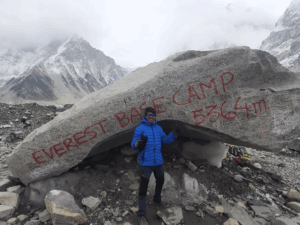
At the Everest Base Camp (5364 mtr)
My ultimate goal is to ascend Mount Everest, so I asked my uncle, who had done it a few years prior in 2018, for advice. He advised me to climb Mount Lobuje because it’s a popular first mountain. and Mount Lobuje is climbed by Everest summiters as a training exercise. We soon decided to complete this peak in 2024. Along with me were my father, my friend Vedant, and his father, Sushant Uncle.
To acclamitize for reaching the summit, we completed the EBC trek once more. Sadly, Sushant Uncle had to return to back down after completing the EBC trek, so the three of us had to continue without him. I was thinking of a number of things. I had some last-minute misgivings and was a little nervous. I was terrified of avalanches, HAPE, HACE and a lot of other things. A day before I left for the high camp, I was quite anxious and doubted myself a lot in Lobuje Village. Uneasy, I was unable to speak.
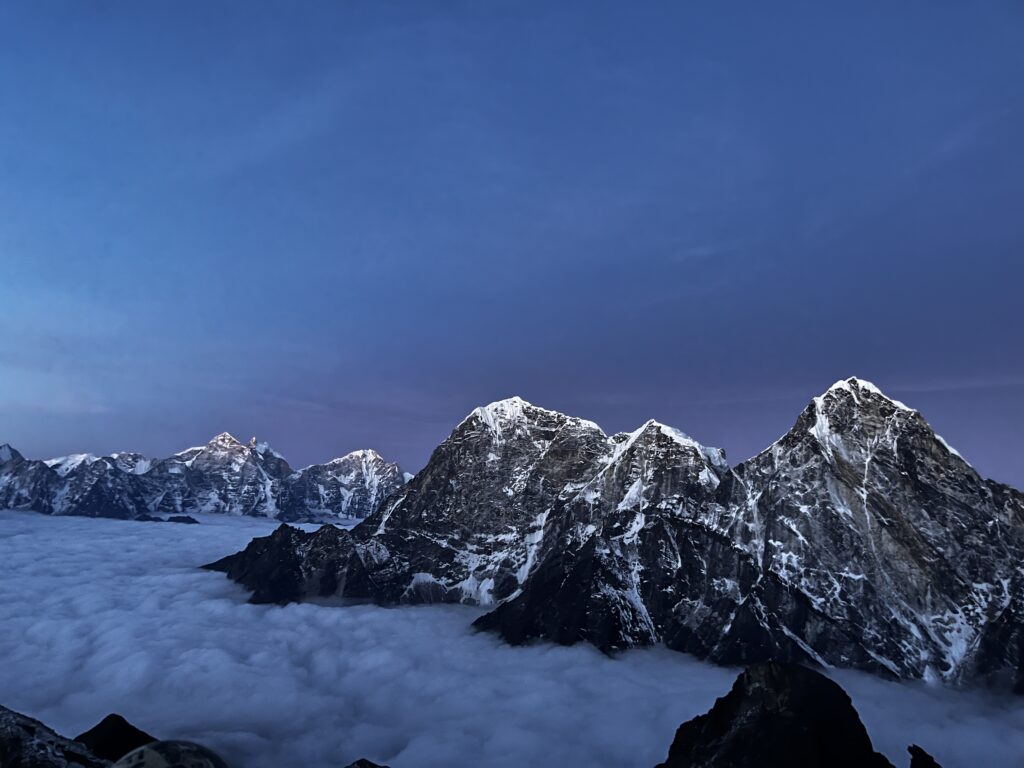
The journey to the high camp was comfortable and easy, which gave us low expectations for the summit attempt the next day. We had a great day at high camp with the beautiful mountains all around. A pleasant one-hour photographic session to pass the time with some small talk. We had to leave by 1am and be there for breakfast at 12.30am, so we wrapped up about 7pm. Despite my prior experience with a few night treks, this one was unlike any of the others. It hurt to wake up around 12:30 a.m. because it was freezing outside the tent. It was a little uncomfortable at first because it was about -16C, but as we got acclimated to it, it was pretty manageable. I was at first both anxious and thrilled, that I was unable to eat much. The first two hours were spent just trekking and weren’t technical. Although the hike was rather strenuous and labor-intensive. The dark silhouettes of the Ama Dablam, Tobuche, Cholatsen, Kangtega, and other mountains would change with each break. I had a strange feeling of serenity and tranquility while climbing in the dark with just headlamps for light, which was really pleasant and lifted my spirits. Even if you could only see the mountains’ outline at night, they nevertheless had a magnificent, sparkling appearance. We avoided fatigue by taking regular breaks and moving at our own pace — neither too fast nor too slow.
The final summit push
After hiking for about an hour and a half, we arrived at the place where we would need to put on a harness and helmet because the route above was quite steep and required some technical climbing, such as rock climbing and jumaring. From then on, it just became harder and harder, with 70–80 degree angles and steep 30-meter rises. The crampon point was thirty minutes away from the harness and helmet point. From that point on, going anywhere would be nearly impossible without crampons because everything was covered in snow and hard ice. Crampon walking is quite difficult. Your feet would get entangled if you kept them closed, so you had to constantly keep them slightly apart. Now that snow and ice had been added to the already difficult, lengthy climbs, it became even more difficult as crampons can occasionally slip and cause us to fall. I traveled from the crampon point to the summit in around 4 hours. I walked at a steady speed for the first two hours, taking breaks around every half an hour. My arms and legs began to hurt from climbing as we continued up. My left shoulder ached, my forearms were tense, and the weight of my bag had ripped off the right strap at the crampon point. The pace slowed and the breaks increased, but I wasn’t going to give up.
My physical and mental stamina were truly put to the test during the last hour that I can recall. We had already ascended to a height of around 6000 meters, and the air had become thinner. Every two to three minutes, I would have to catch my breath. I was growing impatient and wanted to get to the top so that the wretched ascent could stop. On multiple instances, I’d been extremely close to giving up before talking myself out of it. I kept telling myself that it would be a shame to give up as I was only a few meters from the summit. I held my cool and took deep breaths. My uncle recommended deep breathing to me, saying it helped him in climbing Mount Everest. At precisely 7 a.m. on May 30, 2024, I finally reached the summit of Mount Lobuje East after much exertion and mental encouragement. My guide offered me to also climb the Lobuje West Peak, which would have required an additional hour of climbing and an additional 100 meters of altitude. To reach Lobuche West, one had to traverse a 20-meter crevasse and then ascend a straight wall. Since there were no ladders available, the only way to bridge a crevasse was to jump, and I didn’t think I had the strength to jump 20 meters without falling into the crevasse. I now regret turning him down and believe that I should have taken my chances.
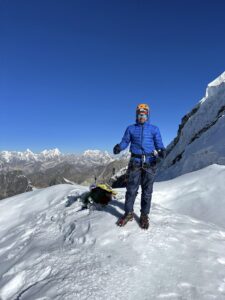
At the top of Mt Lobuje East (6119 mtr)
However, the sensation of achievement I had at reaching the top of Lobuje was beyond my wildest expectations. Right now, it remains my proudest moment in life. The expansive vistas of the mountains were just mesmerizing; believe me, despite the extensive climbing, I have never seen a panorama like that. Together with summits like Ama Dablam, Tobuche, Cholatsen, and Kangtega, the world’s most powerful peaks included Lhotse, Makalu, Cho Oyu, and of course, my favorite mountain, Mount Everest. Around 7.40 am, after taking a few pictures by myself and sipping some apple juice, Vedant arrived at the summit. I waited for him to unwind, celebrate his success, and enjoy the breathtaking sweeping landscapes. Then snapped a few pictures with him. I spent an hour waiting at the top till 8 am, then made the decision to go because the strong winds there were making me feel cold.
My dad, who was only ten minutes away from his peak, ran into me five minutes after I left the summit. After greeting him and expressing my regret for not being able to wait for him, I made my way down to the high camp. I was worn out after the arduous ascent, and the sun’s brightness made me feel even worse. I must have fell over a million times while descending. I once went down head first onto a jagged, hard icicle while descending as the still hooked to the safety line that had slackened. Fortunately, the hemet did not cause any major harm to me, but the jolt gave me a headache. A few minutes after, as we were walking on rocks near the high camp, I stumbled and fell chest-first. I was gasping for air for a frightening moment after that. I was so tired that I had to throw up the apple juice I had while descending. Yes, so while going down, I had pretty much expended all of my energy. Nevertheless, I was able to descend from the summit to the high camp in three hours, at about 11 a.m.
I changed into fresh clothes, flung myself inside my tent, and slept for two hours. At 1:00 pm, as I woke up, Vedant was reaching the high camp. He appeared to be really exhausted too. But following a two-hour nap, I felt considerably better and well rested. After the climb, I had a few problems like body ache and a nasty upset stomach. An hour later, my dad arrived at high camp. Even though he couldn’t walk very well due to a knee injury he had while climbing, he appeared less exhausted than Vedant and I were when we had descended. After lunch, we departed from high camp at 3 p.m. for Pheriche, where we stayed the night before catching a helicopter back to Lukla and an immediate flight back to Kathmandu.
Soaking in the moment at the top
Even though it’s been more than 10 days since my summit, the sense of pride and accomplishment still hasn’t left me. The ascent demands a great deal of physical fitness, some technical knowledge, and — above all — a resilient mental attitude. The climb put me to the test, but it was worthwhile because once you reach the summit, you forget about all the suffering you endured. I feel that by climbing Mount Lobuje I have personally grown by leaps and bounds. The climb has inspired me in many ways, especially the realisation to set far higher standards for myself. I am now confident to take on challenges that seem impossible or ridiculous initially — yes, I am no longer afraid to give it a shot! I consider my experience at Lobuje Peak to be among my best to date, and I have many more mountain experiences planned. My next goal is the Island Peak another 6000 mtr plus peak in Kumbhu region of Nepal before I set out to achieve my dream of climbing the highest point on the planet — Mt. Everest summit.